Media Release, He Toi Whakairo: The Art of Māori Carving – Te Papa celebrates seven centuries of Māori carving in landmark exhibition, Te Papa Blog, 21 May 2026
Seven centuries. 147 taonga. One living, shape-shifting artform. Māori carving is taking centre stage at Te Papa.
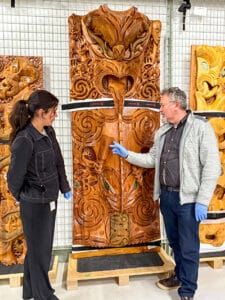
He Toi Whakairo: The Art of Māori Carving is a major new long-term exhibition opening at Te Papa on 29 August 2026. It presents one of the most comprehensive exhibitions of whakairo (Māori carving) in more than four decades, when the historic Te Maori exhibition toured the USA.
Bringing together 147 taonga from Te Papa collections, the exhibition includes works dating back to the 1300s and those of leading contemporary carvers, revealing whakairo as a practice steeped in history and cultural identity and a living, evolving artform.
Visitors will encounter whakairo across a range of forms; taurapa (canoe sternpost), pounamu, poupou (house post), hoe (paddle), taiaha (weapon), taonga puoro (musical instrument), tokotoko (walking stick), karetao (marionette), adornment, and ritual taonga.
The works are carved in traditional and contemporary materials, from wood, bone, stone, pāua, and pounamu to uku (clay), and modern solid surface composites.
From Rangi Kipa’s 2.1 metre-tall hot pink poupou – carved in engineered stone usually seen in kitchen benchtops – to Ngaroma Riley’s puppet self-portrait Kapahaka Queen swinging poi, the exhibition features contemporary works that shake up traditional images of the artform.
Exhibition co-curator Dougal Austin says, “At the heart of the exhibition is the transmission of living knowledge: from stone tools to contemporary technologies, from inherited forms to bold new materials and colours”.
The exhibition features significant carvers of the 1800s–1900s alongside leading contemporary carvers: Tene Waitere, Hōne Ngatoto, Ānaha te Rāhui, Wero Tāroi, Charlie Tuarau, Dr Lyonel Grant, Rangi Kipa, Sam Hauwaho, Fayne Robinson, Clive Fugill, Matthew Randall, and Riki Manuel.
He Toi Whakairo foregrounds wāhine tā whakairo (female carvers) Stevei Houkāmau and Ngaroma Riley, reclaiming spaces historically dominated by men.
Jana Pātete, co-curator, acknowledges the historical precedents and the work of women carvers today.
“This exhibition brings together wāhine Māori artists who are navigating male-dominated carving traditions and reshaping them through their own whakapapa, resistance, and innovation.”
“To remind us that wāhine tā whakairo have always been here, we look back to figures like Jane Topia, who carved an entire wharenui in the 1930s.”
The timing of the exhibition is particularly significant for Te Papa, coming forty years after the historic Te Maori exhibition, which brought taonga Māori to the world stage.
Te Papa Kaihautū | Māori co-leader Dr Arapata Hakiwai expects the exhibition to draw global attention.
“From its strong foundation of mātauranga Māori and te ao Māori, this exhibition engages with global conversations around Indigenous art, museum practice, and cultural continuity.” The exhibition is guided by the whakatauākī (proverb) coined by Māori leader Piri Sciascia at the time of Te Maori: ‘He Toi Whakairo, He Mana Tangata | Where there is artistic excellence, there is human dignity’.
This five-year exhibition is supported by Wellington City Council, Te Papa Foundation, Go Media, Wellington Airport, and Dulux.
More info: tepapa.nz/HeToiWhakairo
Highlights/exhibition by numbers
- Taonga never previously displayed to the public.
- 147 taonga from Te Papa collection.
- Over 700 years of whakairo.
- Works dating back to the 1300s.
- 9 taonga made/produced in the Wellington region.
- Oldest: A pair of Rei Niho Paraoa (chevron type sperm whale tooth pendants) dated around the year 1300 making it the oldest taonga in the exhibition.
- Biggest: At 3.4 metres tall is Matthew Randall’s pou tokomanawa Ko Ruapani.
- Smallest: Uhi (tattooing chisel) 30mm x 10mm
- Newest: commissioned for the exhibition, Sam Hauwaho carved Whaka-iro in 2025.
- Heaviest: Wero Tāroi’s poupou Taporahitaua weighs 149kg.