
Media Release, Meteorite recovered in Tekapo to go on display at Tūhura Otago Museum, Otago Museum, April 2026
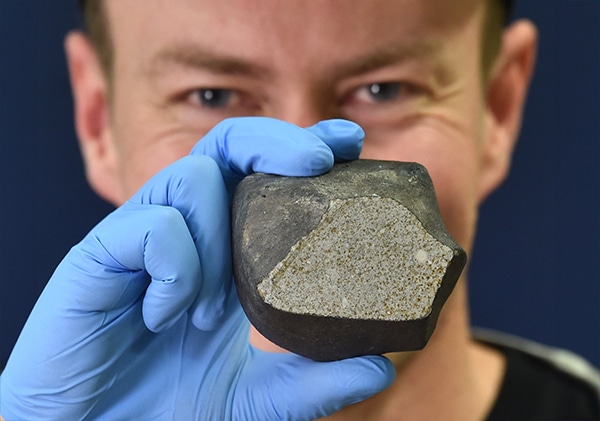
A meteorite that fell over the Mackenzie Basin in March 2024 will go on public display at Tūhura Otago Museum this April, offering visitors the chance to see one of only ten meteorites ever recovered in New Zealand.
The Takapō meteorite was discovered just eight days after it was tracked entering the atmosphere, ending a 20-year gap since the last meteorite recovery in New Zealand in 2004.
The space rock blazed across the South Island sky on the evening of 13 March 2024 before landing near Tekapo. The fireball was seen by Dennis Behan from his spa bath. Scientists were able to predict where it would fall using the Fireballs Aotearoa camera network, a system designed to track meteors entering the atmosphere.
After modelling its flight path, a group of 24 volunteers searched the predicted fall zone. The meteorite was surprisingly found within thirty minutes by the team.
Weighing 810 grams when it landed and roughly the size of a fist, the Takapō meteorite has since been cut to reveal its internal structure. Scientists say some of the minerals inside can only form in space and are only found on Earth through meteorites.
Dr Marshall Palmer, a geologist in the Department of Geology at the University of Otago, helped coordinate the recovery effort and has been analysing the meteorite to better understand its origins.
“Analysis shows the Takapō meteorite is an L5 ordinary chondrite and therefore was part of a parent asteroid between 100 and 1000 kilometres in diameter. This group of meteorites usually have Ar-Ar ages of ~470 million years, which is attributed to the fragmentation event of the parent body; however, Ar-Ar dating of the Takapō meteorite is still progressing as initial results were not clear. In any case, this fragment has spent hundreds of millions of years orbiting the Sun before eventually intersecting with Earth’s orbit and falling in New Zealand,” Dr Palmer said.
Tūhura Otago Museum Curator Natural Science Kane Fleury said the discovery is an extraordinary opportunity for the public to see a piece of deep space history up close.
“The Takapō meteorite has travelled through space for hundreds of millions of years before landing in our own backyard, and we are thrilled that visitors can now come to Tūhura to see it for themselves,” Fleury said.
“This discovery was only possible thanks to the Fireballs Aotearoa project, funded through the Government’s Participatory Science Platform, which supported the research and camera network needed to track and recover meteorites like this. Sadly, that funding programme no longer exists, which is a real loss given the discoveries it enabled for this project are significant not just for New Zealand but internationally.”
Meteorites are extremely rare finds in New Zealand. The Takapō meteorite is the first discovered in the country since 2004.
Tūhura Otago Museum holds two of the ten meteorites ever recovered in New Zealand. The other is the Morven meteorite, discovered on a South Canterbury farm in 1925 and weighing around seven kilograms.
The Takapō meteorite will go on display in the Southern Land, Southern People gallery from Thursday 23 April.
The discovery has also inspired a children’s book. Search team member Steve Wyn-Harris has written The Day I Crashed to Earth, telling the story of the meteorite’s journey and discovery. The book is available from the Tūhura Museum Shop.